Showing posts with label Feasts. Show all posts

Monday, May 30, 2011

Feast of the Visitation


Feast of The Visitation and Unveiling of Our Lady's Statue

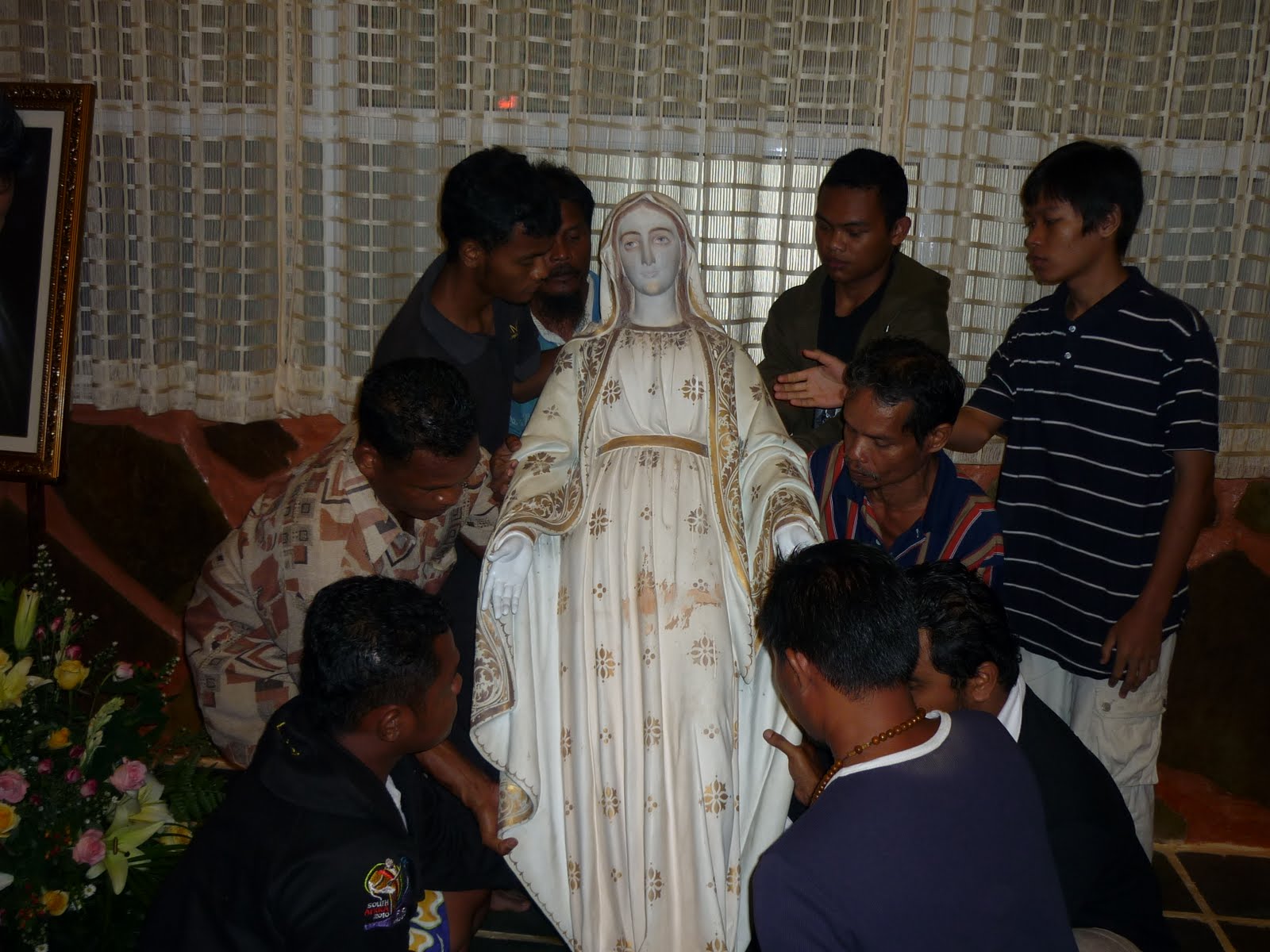
On Saturday, 28th May, we celebrated the 6th day of novena with the unveiling of our Lady’s statue with a Special Blessing. Throngs of people turned up for this historical event. People of all ages, from the elderly to the young gathered for this momentous occasion which started at 1715hrs with the rosary to Our Lady followed by mass, which was celebrated by Parish Priest, Fr. George Packiasamy and Asst. Priest Fr. Andrew Kooi.

It was then followed by a candle light procession with the Blessed Sacrament in Seremban town, a first after 1950s. The faithful parishioners continued with reciting the rosary and singing.

The procession ended back at the main entrance of Church where the refreshed statue of the Our Lady of Immaculate Conception was unveiled looking serenely over Seremban town as she has for the past 45 years. Doves were set free and the night ended with breathtaking fireworks, food and fellowship.

History of the 78-year old statue of Our Lady of Immaculate Conception of Church of the Visitation:

It was first installed in the main sanctuary of the Church of Visitation in 1933 by Fr Georges Auguin an MEP priest and (the then) Fr Dominic Vendargon. In 1966 residents priests at the Visitation – Fr Paul Wan, Fr Edward Limat, Fr Pallier and Fr Joseph Tsai – had the statue relocated to the front of the Church. It was elevated above the main entrance overlooking Seremban town.

Forty-Five years later on 12 May 2011 the statue was taken down and intending to replace it with the two statues depicting the identity of the parish of the Visitation – Mother Mary visiting Elizabeth but it didn’t materialised at the end. On the 28th May the 78- year old statue of Our Lady was restored to its original. She is very happy now happy to have “gone back home”. The two new statues depicting the Visitation is now placed in the grotto for the moment.

(Written by Samantha Wong)


"I alone cannot change the world, but I can cast a stone across the waters to create many ripples."
Mother Teresa
"If we pray, we will believe; If we believe, we will love; If we love, we will serve."
Mother Teresa

Thursday, May 26, 2011

FACADE AND SANCTUARY


The new look of the facade
of Church of the Visitation and sanctuary
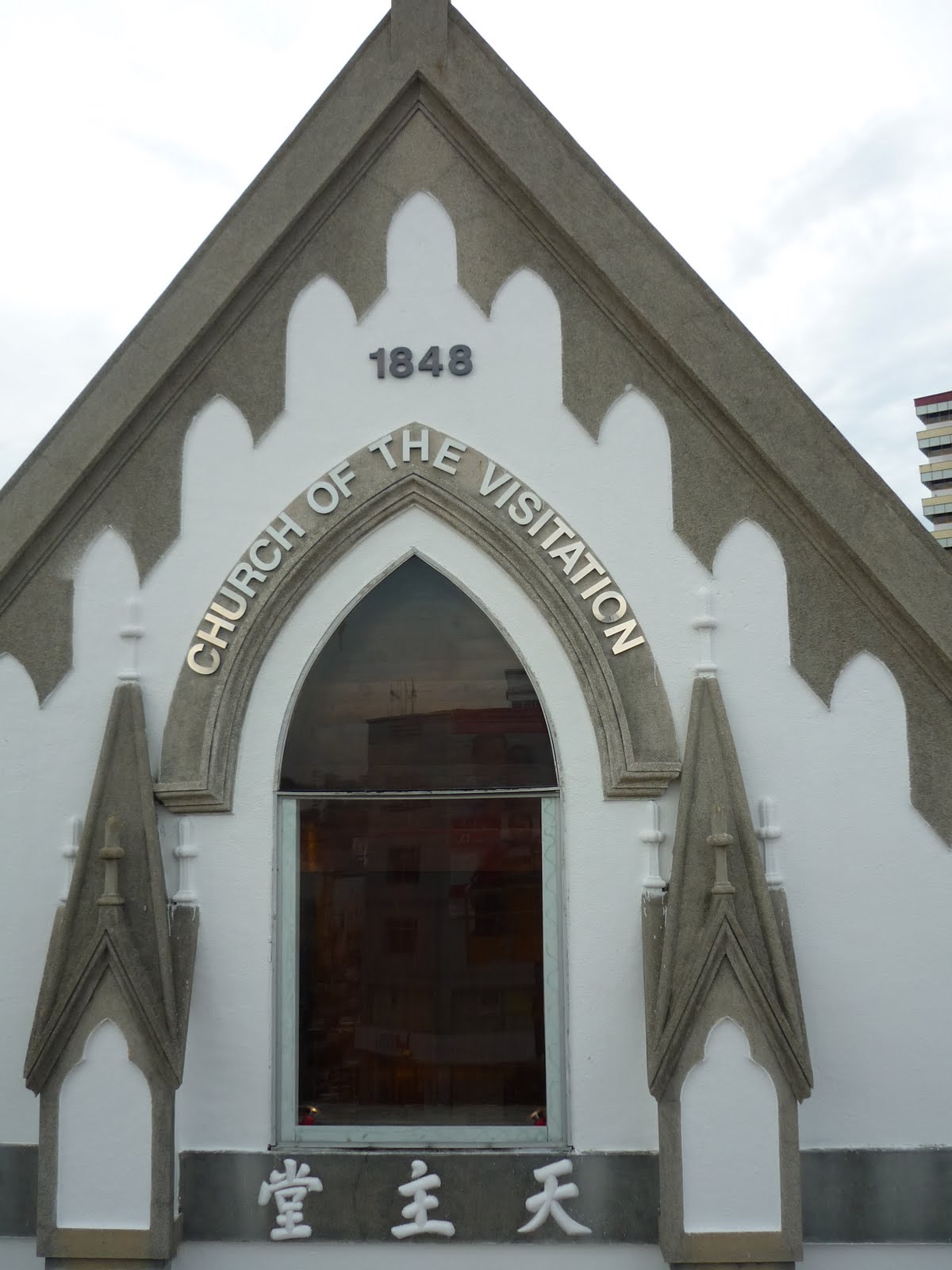
On Wednesday, 25th May, we celebrated the 3rd day of novena for the feast of the Visitation. About 800 people came for the Eucharistic celebration celebrated by Fr Simon Labrooy. The Church sanctuary has been brightened up with warm lights and the facade of the Church was fixed with the stainless steel lettering. A special blessing will take place on 28th May, 2011 at sunset Mass @ 5.45 pm followed by the procession in the town.
All are welcome!

Monday, June 14, 2010

Closing Year of the Priest & Welcome Fr Andrew Kooi


Visitation parish closed the Year of the Priest last Friday on the Solemnity of the Sacred Heart of Jesus, June 11, 2010. Elsewhere, Pope Benedict XVI and Archbishop Murphy Pakiam also both marked the same date as the closing for the Year of the Priest in Rome and Kuala Lumpur (St Anthony's Church) respectively.

During the homily delivered in 3 languages, Rev Fr George Packiasamy, the new Parish Priest, reiterated the principal goals of the Year of the Priest. He also spoke of the exemplary life of St John Marie Vianney, the Cure D'Ars, the patron of Parish Priests.

The day also served as a warm welcome to Fr Andrew Kooi, who has been appointed Assistant Parish Priest, w.e.f 10th June 2010. Fr Andrew Kooi has just returned from two years Mandarin studies in Taiwan. Fr Kooi is also an accomplished musician who has an internationally acclaimed website featuring many of his personal compositions for Mass sung parts and musical arrangements for responsorial psalms.

Sunday, May 30, 2010

Parish Feast Day Dinner Fellowship and Farewell for Fr Michael


The Parish of Visitation celebrated the final day of its Feast Day Triduum on Saturday, 29 May, with Mass in four languages followed by dinner fellowship for all parishioners. Several parish groups provided performances for the evening entertainment. The Parish also took this opportunity to bid farewell to Fr Michael Chua who has been with the parish for the last 6 1/2 years, the earlier 3 1/2 years as Assistant to Fr Albet Arockiasamy and the last 3 years as Parish Priest. Fr George Packiasamy will succeed Fr Michael as Parish Priest with effect from 1st June 2010.

More Photos on Facebook. More videos on The Welcoming Parish Youtube Channel.


Thursday, May 27, 2010

Reading the Word of God


Homily Outline for 1st day of Parish Triduum

What is the Bible?
Biblos – Library of Books – “The Bible is God’s self revelation to man in history inviting man to respond” or “The WORD OF GOD in the words of men”

Definition helps us to have 2 attitudes when reading the Bible:
1. It is God’s Word – it is truly God speaking to us and inviting us to respond – so we must read with the eyes of FAITH;
2. It is written in the words of men – God chooses human persons like you and me to write down his Word. These human authors live at a certain time, in a certain place, have a certain culture, speak a certain language. So it is equally important to try and discover and understand all these factors if we are to read, study and understand the Word of God.

Here are some important points:
1. Select a good bible (good and accurate translations, footnotes and good introductions)
2. Note Geographical, Historical and Cultural Background.
3. Know the Circumstances of Writing: Audience, Time, Place and Other Factors.
4. Interpret According to the Purpose of the Writer.
5. Recognise the Form of Literature.
6. Interpret According to the Grammar of the Passage.
7. Get at the Meaning of Single Words, but always study them in their setting.
8. Interpret a Passage in the Light of its Context.
9. Interpret any Passage in the Light of the Whole Bible Teaching & Analogy of Faith (Analogy of Faith/ Rule of Faith – what is necessary in terms of faith and morals for salvation)
10. Interpret it within the Church – the light of Tradition guided by Magisterium

How do we start?
1. Start by reading the gospel (esp the Gospel of Mark), because the whole Bible is focused on the gospel of Jesus Christ. Old Testament is preparation for the gospel of Jesus Christ. The New Testament is how the Christian community lives out the gospel.
2. Use the Sunday readings or daily mass readings – there are reflections which can be found in Shalom, Word Among us (Tamil/Mandarin – you have other resources including The Herald)
3. Join a Bible Study group or start one among your friends or in your BEC.

More photos on Facebook.

Lectio Divina Meditation for Holy Trinity Sunday Year C

Holy Trinity Sunday Year C
May 30
“Revealing the Truth”

1. Lectio
John 16:12-15
12 “I have much more to tell you, but now it would be too much for you to bear.
13 When, however, the Spirit comes, who reveals the truth about God, he will lead you into all the truth. He will not speak on his own authority, but he will speak of what he hears, and will tell you of things to come. 14 He will give me glory, because he will take what I say and tell it to you. 15 All that my Father has is mine; that is why I said that the Spirit will take what I give him and tell it to you.

Comments
The Holy Spirit continues to be our focus. After the Holy Spirit was revealed on Pentecost Sunday, we can now fully understand the fullness of the revelation that God is Trinity – Father, Son and Holy Spirit. Here Jesus teaches that the role of the Holy Spirit is to ‘reveal the truth about God’, to ‘lead you into all the truth’ and ‘tell you of things to come’ (verse 13). Jesus could have explained more to his disciples at this point about what is going to happen but he knows that they would not be able to take any more in. So he chooses instead to give them glimpses of the work of the Holy Spirit. After Jesus’ resurrection the Holy Spirit will help the disciples understand what they need to know in order to live in relationship with God and give them the power they need to do so (Acts 1:8). Jesus explains more about the relationship between the Holy Spirit, the Father and himself. The Holy Spirit helps us understand and see the truth about God and guides us. In this way he brings glory to the Father and the Son. The three members of the Holy Trinity are one in complete unity.

2. Meditatio
1. Choose a word or a phrase that touches you. Speak it out aloud three times in a prayerful manner.
2. Spend a moment of silence, remembering the word or phrase you have chosen or you have heard from others in the group.
3. Share the reason why you have chosen this word or this phrase with the other members of the group.

3. Oratio
Father,
you sent your Word to bring us truth
and your Spirit to make us holy.
Through them we come to know
the mystery of your life.
Help us to worship you,
one God in three Persons,
by proclaiming and living our faith in you.
We ask you this, Father, Son, and Holy Spirit,
one God, true and living, for ever and ever.

4. Contemplatio
Contemplate the intimate union the Father has for the Son and the Son for the Father and how this love is expressed perfectly in the Holy Spirit.

5. Actio
1. Personal Life – Go back and read the section on the Holy Trinity (you can find it in the index) in the Catechism of the Catholic Church.
2. Communal Life – Make a list of all the members of the community, especially of the sick and elderly. Make a commitment to pray for each of them during this week/ month.

Saturday, May 22, 2010

Pentecost Sunday

Pentecost (Ancient Greek: πεντηκοστή [ἡμέρα], pentekostē [hēmera], "the fiftieth [day]") is one of the prominent feasts in the Christian liturgical year commemorating the descent of the Holy Spirit upon the disciples of Christ. The feast is also called Whitsun, Whitsunday, Whit Sunday, or Whitsuntide, especially in the United Kingdom. Pentecost is celebrated seven weeks (50 days) after Easter Sunday, hence its name. Pentecost falls on the tenth day after Ascension Thursday.

Pentecost is historically and symbolically related to the Jewish harvest festival of Shavuot, which commemorates God giving the Ten Commandments at Mount Sinai fifty days after the Exodus. Among Christians, Pentecost commemorates the descent of the Holy Spirit upon the Apostles and other followers of Jesus as described in the New Testament Acts of the Apostles 2:31 during these Jewish "fiftieth day" celebrations in Jerusalem. For this reason, Pentecost is sometimes described as the "Birthday of the Church".

The biblical narrative of Pentecost is given in the second chapter of the Book of Acts. As recounted in Acts 2:1-4:

"On the day of Pentecost all the Lord’s followers were together in one place. Suddenly there was a noise from heaven like the sound of a mighty wind. It filled the house where they were meeting. Then they saw what looked like fiery tongues moving in all directions, and a tongue came and settled on each person there. The Holy Spirit took control of everyone, and they began speaking whatever languages the Spirit let them speak."
The apostles received the Holy Spirit and were miraculously enabled to go out into Jerusalem prophesying and speaking in languages that all the visitors to Jerusalem could understand as told further in Acts 2:5-6.

Eastern churches

In the Eastern Orthodox Church, Pentecost is one of the Orthodox Great Feasts and is considered to be the highest ranking Great Feast of the Lord, second in rank only to Pascha (Easter). The service is celebrated with an All-night Vigil on the eve of the feast day, and the Divine Liturgy on the day of the feast itself. Orthodox temples are often decorated with greenery and flowers on this feast day, and the celebration is intentionally similar to the Jewish holiday of Shavuot, which celebrates the giving of the Mosaic Law.

The feast itself lasts three days. The first day is known as "Trinity Sunday"; the second day is known as "Spirit Monday" (or "Monday of the Holy Spirit"); and the third day, Tuesday, is called the "Third Day of the Trinity."

The Orthodox icon of the feast depicts the Twelve Apostles seated in a semicircle (sometimes the Theotokos (Virgin Mary) is shown sitting in the center of them). At the top of the icon, the Holy Spirit, in the form of tongues of fire, is descending upon them. At the bottom is an allegorical figure, called Kosmos, which symbolizes the world. Although Kosmos is crowned with earthly glory he sits in the darkness caused by the ignorance of God. He is holding a towel on which have been placed 12 scrolls, representing the teaching of the Twelve Apostles.

The typical image of Pentecost in the West is that of the Virgin Mary seated centrally and prominently among the disciples, with flames resting on the crowns of their heads. Occasionally parting clouds suggesting the action of the “mighty wind”[18], rays of light, and/or the Dove, are also depicted. Of course, the Western iconographic style is less static and stylized than that of the East, and other very different representations have been produced, and in some cases have achieved great fame, such as the Pentecosts by Titian, Giotto and el Greco.


Wednesday, May 12, 2010

Feast of the Ascension of the Lord

Tomorrow, the Church celebrates the Feast of the Ascension of the Lord. It is the fortieth day after Easter Sunday, commemorating the Ascension of Christ into heaven, according to Mark 16:19, Luke 24:51, and Acts 1:2.

In the Eastern Church this feast was known as analepsis, the taking up, and also as the episozomene, the salvation, denoting that by ascending into His glory Christ completed the work of our redemption. The terms used in the West, ascensio and, occasionally, ascensa, signify that Christ was raised up by His own powers. Tradition designates Mount Olive near Bethany as the place where Christ left the earth.

The feast always falls on a Thursday (40 days after Easter). It is one of the Ecumenical feasts ranking with the feasts of the Passion, of Easter and of Pentecost among the most solemn in the calendar. Belief in the Ascension of Jesus is found in the Nicene Creed, and is affirmed by Christian liturgy and, in the West, by the Apostles' Creed.

The observance of this feast is of great antiquity. Although no documentary evidence of it exists prior to the beginning of the fifth century, St. Augustine says that it is of Apostolic origin, and he speaks of it in a way that shows it was the universal observance of the Church long before his time. Frequent mention of it is made in the writings of St. John Chrysostom, St. Gregory of Nyssa, and in the Constitution of the Apostles. Representations of the mystery are found in diptychs and frescoes dating as early as the fifth century.

In Eastern Orthodox and Oriental Orthodox theology, the Ascension is interpreted as the culmination of the Mystery of the Incarnation, in that it not only marked the completion of Jesus' physical presence among his apostles, but consummated the union of God and man when Jesus ascended in his glorified human body to sit at the right hand of God the Father. The bodily Ascension into heaven is also understood as the final token of Christ's two natures: divine and human. The Orthodox doctrine of salvation points to the Ascension to indicate that the state of redeemed man is higher than the state of man in Paradise before the fall.The Orthodox understand Christ's physical presence to continue in the Church, which is the "Body of Christ".[1 Cor 12:12-27] Jesus' promise that he will be "with you always" is understood not only in terms of his active, divine grace, but also in the divine institution of the church (human sinfulness notwithstanding).

Christ's Ascension into heaven is understood as a necessary prerequisite for the sending of the Holy Spirit at Pentecost,[Jn 14:15-20] [14:25-28] [15:26] and especially [16:7].

Wednesday, May 5, 2010

Parish Feast Day Triduum - Mass Schedule

"The Bible, A Guide for our Steps and a Light for the World"


Day 1 - Parish Feast Triduum
Thursday, May 27, 2010 - "Reading the Word of God"
7.00 pm Rosary
7.30 pm Mass (3 languages)

Day 2 - Parish Feast Triduum
Friday, May 28, 2010 - "Praying the Word of God"
7.00 pm Rosary
7.30 pm Mass (3 languages)

Parish Feast Day - Feast of the Visitation
Saturday, May 29, 2010 - "Living the Word of God"
(No Novena)
5.15 pm Rosary
5.45 pm Feast Day Mass (4 languages)

(followed by dinner fellowship)

ALL ARE WELCOME
Come and savour the Word of God! The Word of God will come alive in these 3 days of our preached Triduum. Learn to read it, pray with it and finally live it to the fullest!

Wednesday, March 24, 2010

Solemnity of the Annunciation of Our Lord - March 25


The Annunciation is the Christian celebration of the announcement to Mary by the angel Gabriel that she would become the Theotokos (God-bearer). Even though a virgin, Mary would conceive a child who would be the Son of God. Gabriel told Mary to name her son Jesus (“Yahweh delivers”). Most of Christianity observes this event with the Feast of the Annunciation on 25 March.

The Feast of the Annunciation, March 25, is one of the most important in the Church calendar. It celebrates the actual Incarnation of Our Savior the Word made flesh in the womb of His mother, Mary.

The biblical account of the Annunciation is in the first chapter of the Gospel of Saint Luke, 26-56. Saint Luke describes the annunciation given by the angel Gabriel to Mary that she was to become the mother of the Incarnation of God.

Here is recorded the "angelic salutation" of Gabriel to Mary, 'Hail, full of grace, the Lord is with thee" (Ave, gratia plena, Dominus tecum - Lk 1:28), and Mary's response to God's will, "Let it be done to me according to thy word" (fiat mihi secundum verbum tuum) (v. 38)

This "angelic salutation" is the origin of the "Hail Mary" prayer of the Rosary and the Angelus (the second part of the prayer comes from the words of salutation of Elizabeth to Mary at the Visitation).

The Angelus, a devotion that daily commemmorates the Annunciation, consists of three Hail Marys separated by short versicles. It is said three times a day -- morning, noon and evening -- traditionally at the sound of a bell. The Angelus derives its name from the first word of the versicles, Angelus Domini nuntiavit Mariae (The Angel of the Lord declared unto Mary).

The Church's celebration of the Annunciation is believed to date to the early 5th century, possibly originating at about the time of the Council of Ephesus (c 431). Earlier names for the Feast were Festum Incarnationis, and Conceptio Christi, and in the Eastern Churches, the Annunciation is a feast of Christ, but in the Latin Church it is a feast of Mary. The Annunciation has always been celebrated on March 25, exactly nine months before Christmas Day.

Two other feasts honoring Our Lord's mother, the Assumption (August 15), and the Immaculate Conception (December 8), are celebrated as Holy Days of Obligation in the United States and many other countries (Malaysia only observes Assumption as a day of obligation). New Year's Day, January 1, is observed as a Solemnity of Mary. The Annunciation was a Holy Day throughout the Universal Church until the early 20th century. Many Catholics who are deeply concerned with the defense of the life of unborn children believe it would be fitting if the Feast of the Annunciation were restored to this status. Although it seems unlikely that it will be added to the Church calendar as a Holy Day of Obligation, we can certainly take on the "obligation" ourselves to attend Mass.

One sign of the significance this Christian feast had throughout Western culture is that New Year's Day was for centuries celebrated on March 25. It was believed by some ancient Christian writers that God created the world on March 25, and that the fall of Adam and the Crucifixion also took place March 25. The secular calendar was changed to begin the year on January 1 (in 1752 in England and colonies, somewhat earlier on the continent).

The Annunciation in Islam


Islam shares a similar tradition of honouring Mary as mother of Jesus (but not Mother of God). Apart from the similarities, there are also other significant differences in the narrative of Jesus' conception and birth, e.g. no mention of Joseph as the foster father,the place of birth etc. References to the Annunciation are found in two verses of the Quran:

Sura 3 (Al-i-Imran - The Family of Imran) verses 45-51:

45Behold! the angels said: "O Mary! Allah giveth thee glad tidings of a Word from him: his name will be Christ Jesus, the son of Mary, held in honour in this world and the Hereafter and of (the company of) those nearest to Allah: 46"He shall speak to the people in childhood and in maturity. And he shall be (of the company) of the righteous." 47She said: "O my Lord! How shall I have a son when no man hath touched me?" He said: "Even so: Allah createth what he willeth: When he hath decreed a plan, he but saith to it, 'Be,' and it is! 48"And Allah will teach him the Book and Wisdom, the Law and the Gospel, 49"And (appoint him) a messenger to the Children of Israel, (with this message): "'I have come to you, with a Sign from your Lord, in that I make for you out of clay, as it were, the figure of a bird, and breathe into it, and it becomes a bird by Allah's leave: And I heal those born blind, and the lepers, and I quicken the dead, by Allah's leave; and I declare to you what ye eat, and what ye store in your houses. Surely therein is a Sign for you if ye did believe; 50"'(I have come to you), to attest the Law which was before me. And to make lawful to you part of what was (Before) forbidden to you; I have come to you with a Sign from your Lord. So fear Allah, and obey me. 51"'It is Allah who is my lord and your lord; then worship him. This is a way that is straight.'"

And Sura 19 (Maryam - Mary) verses 16-26; both Suras without mentioning Jesus as the son of God:

16Relate in the Book (the story of) Mary, when she withdrew from her family to a place in the East. 17She placed a screen (to screen herself) from them; then we sent her our angel, and he appeared before her as a man in all respects. 18She said: "I seek refuge from thee to ((Allah)) Most Gracious: (come not near) if thou dost fear Allah." 19He said: "Nay, I am only a messenger from thy Lord, (to announce) to thee the gift of a holy son. 20She said: "How shall I have a son, seeing that no man has touched me, and I am not unchaste?" 21He said: "So (it will be): Thy Lord saith, 'that is easy for me: and (we wish) to appoint him as a sign unto men and a mercy from us':It is a matter (so) decreed." 22So she conceived him, and she retired with him to a remote place. 23And the pains of childbirth drove her to the trunk of a palm-tree: She cried (in her anguish): "Ah! would that I had died before this! would that I had been a thing forgotten and out of sight!" 24But (a voice) cried to her from beneath the (palm-tree): "Grieve not! for thy Lord hath provided a rivulet beneath thee; 25"And shake towards thyself the trunk of the palm-tree: It will let fall fresh ripe dates upon thee. 26 "So eat and drink and cool (thine) eye. And if thou dost see any man, say, 'I have vowed a fast to ((Allah)) most gracious, and this day will I enter into not talk with any human being'".

Monday, March 22, 2010

Chrism Mass - March 24, 2010


The Mass of Chrism comes once a year. In our Archdiocese of Kuala Lumpur and in many other dioceses around the world, it is usually celebrated in the cathedral, the mother church of the diocese. However in recent years, the Chrism Mass in the Archdiocese of Kuala Lumpur has also been celebrated in various parishes to encourage greater participation from various sectors of the diocesan community. If you've never celebrated it, you're missing one of the most solemn and significant liturgies of our church.

This year's celebration will be in our district, the District (State) of Negeri Sembilan, in the Church of St. John M. Vianney, who is the patron saint of pastors and parish priests. The location has been chosen in conjunction with the Year of the Priest (2009-2010) and the fact that the Church of St. John Vianney in Tampin has been designated a pilgrimage centre.

At the Chrism Mass -- which is usually the largest annual gathering of clergy and faithful most dioceses have -- the priests renew the commitments they made at their ordination. The Mass takes its name from the most eminent of the three holy oils which the bishop commissions for his local church's use over the following year.

While the Oil of the Sick, used for those who seek the anointing, and the Oil of the Catechumens, which is imposed on those preparing for baptism, are simply "blessed," the Sacred Chrism is "consecrated," and all the priests present participate in the latter moment by extending their hands toward the vessel containing it as the bishop says the prayer of consecration.

The Chrism is used at the ordination of priests and bishops, baptisms, confirmations, the consecration of altars and the blessing of churches, where the walls are smeared with it in the shape of the sign of the cross.

As part of the consecration of the Chrism, balsam is poured into the oil, which gives it a sweet smell intended to remind those who encounter it of the "odor of sanctity" to which those people and things who are marked with it, and by extension all of us, are called to strive for.

Since the bishop is the only minister in the diocese who may consecrate chrism, this Mass highlights his ministry and our union with him. He will not baptize and confirm everyone in the parishes of the diocese, but he will be symbolically present in the chrism which the priests and deacons will use.

The Chrism Mass also provides an opportunity the faithful of the diocese to show support for their priests.

Tuesday, March 2, 2010

Chinese New Year Thanksgiving Lunch 2010


The Mandarin Apostolate of the Church of Visitation organised and hosted this year's Chinese New Year Thanksgiving Lunch on Sunday, February 28. This was also the last day of the Spring Festival, popularly known in Hokkien as Chap Goh Meh (the 15th day). The last day of the CNY festivities is also known, especially among the Hokkien community, as the Chinese Valentine's Day.

This year's celebration was particularly different as it was jointly hosted and organised by the KL Archdiocesan Chinese Apostolate (ACLAC). Members of the Chinese Apostolate from other non-Negeri Sembilan district parishes were also invited to participate in the celebrations. Therefore, the venue was moved to Min Kok Restaurant to accommodate the 71 tables.

More photos on Facebook.